
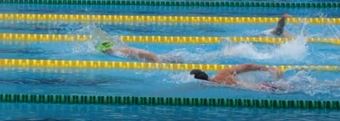
From my experiences as a swimmer and as a coach, I’ve come to realise that sprinting is often not seen as a skill by age-group and masters swimmers. This comes from a common misconception that sprinting simply means to “go all out” or “put everything into it”. The problem with only using these phrases is that it equates sprinting with simply moving as fast as possible and driving yourself to exhaustion. While these are both aspects of a sprint, they are leaving out some very important parts. Anyone can hop into a pool and spin their arms around until they are exhausted, but it doesn’t mean they are sprinting, at least not correctly, and it certainly doesn’t mean they are reaching their potential in terms of speed.
Different distances require swimmers to employ different types of technique. The way someone will swim freestyle will differ depending on the event. Watch the differences between elite swimmers in the various freestyle events, the way someone swims the 1,500m is very different to how the 50m is swam. For the majority of their race most elite distance freestylers will employ a 2 beat kick, barely kick off the walls, will breath every two strokes, and will try to keep a long efficient hip-driven stroke. By comparison those swimming the 50m will work hard off the blocks (and wall if it is short course), they will typically swim with a straight arm recovery, the men won’t take any breaths, the underwater pull can vary between straight arm, bent arm or a hybrid, they use shoulder driven freestyle and aim to be a little higher in the water.
So how do we make better sprinters? Personally, I see sprinting as a skill that swimmers need to develop and the best way to develop a skill is to practice it. Now this doesn’t simply mean having swimmers go as hard as possible. We need to explain to swimmers how to adapt their technique for a sprint. They will need feedback on their sprinting especially in regards to body position, head position, and propulsion. On Swim Ireland courses we were told that when a swimmer doubles their speed their resistance cubes. In other words, if S is speed and R is resistance then 2S results in R3. So, swimmers need to avoid thrashing the water and work to reduce resistance. Dives, underwaters, breakouts, and turns also need a lot of attention as they can make a huge difference over 50m. Personally I encourage swimmers to get into the mindset of attacking these elements, they should be seen as a chance to get ahead of the rest of the heat/final.
Of course, we also need to give swimmers the opportunity to sprint. If we keep them short with adequate rest then sprints can be done in almost any training session. Personally, I like to give swimmers a few rounds of 20-25m max off the blocks just after the warm up and before the main set. In my old club we used to do relays at the end of a session, the losing team had to take out the lane ropes and put away the equipment that was on deck. For pure sprint sessions equipment such as paddles, fins, cords etc can be used to stimulate different feeling for the water and to keep things interesting for the swimmer. Said sprint sessions can be anaerobic where we try to deplete glycogen stores, but they don’t have to be. A sprint session with short sprints and enough rest in between to avoid lactate acid is also valuable. Additionally I have found that the more I practice sprinting, the more time I have when sprinting to think about different aspects of my stroke.
So, hopefully if you are reading this I have convinced you to look at sprinting in a different light, or maybe I have confirmed something you already thought.
 pullkickswim.com
Leave a comment